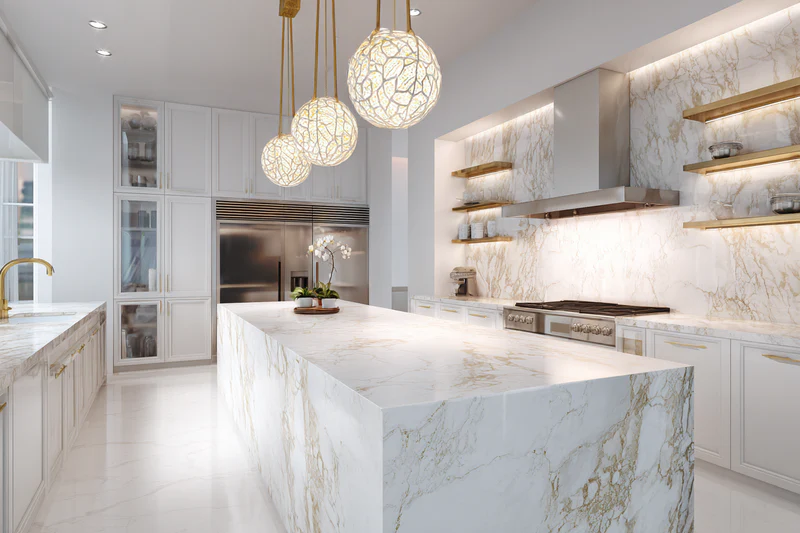

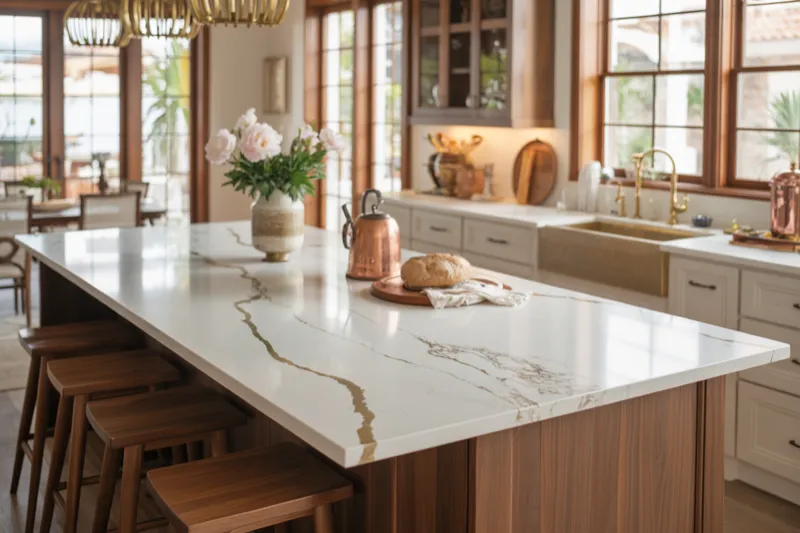
Quartz countertops are the most popular countertop material in America, and for good reason. They combine the beauty of natural stone with the low-maintenance durability that busy homeowners need. Whether you are renovating a kitchen in Boca Raton, upgrading a bathroom vanity in Fort Lauderdale, or building a brand new home anywhere in South Florida, quartz countertops deserve serious consideration. But with so many options, brands, colors, and price points available, choosing the right quartz countertop can feel overwhelming.
This guide is designed to answer every question you might have. We will cover what quartz countertops are, how they are manufactured, the pros and cons you need to weigh, whether they resist heat and stains, how much they cost, which brands lead the market, and how to care for them once they are installed. By the end, you will have the knowledge to make a confident, informed decision about whether quartz is right for your home. At Griffin Quartz, we have fabricated and installed thousands of quartz countertops across South Florida, and we are sharing everything we have learned in this comprehensive guide.
What Are Quartz Countertops?
Quartz countertops are an engineered stone surface made by combining ground natural quartz crystals with polymer resins, pigments, and binding agents. The typical composition is approximately 90 to 95 percent ground quartz and 5 to 10 percent resins and color additives. This is not to be confused with a quartzite countertop, which is a completely different natural stone — we explain the difference in detail in our quartz vs quartzite comparison guide.
The term "engineered" is key. Unlike granite, marble, or quartzite — which are cut directly from blocks of natural stone — quartz countertops are manufactured in a controlled factory environment. The raw quartz mineral is one of the hardest and most abundant minerals on Earth, rating a 7 on the Mohs hardness scale. By grinding this mineral into fine particles and bonding it with advanced polymer resins, manufacturers create a surface that is harder, more consistent, and more stain-resistant than most natural stones.
The result is a slab that looks and feels like natural stone but offers practical advantages that natural stone cannot match. Quartz countertops are completely non-porous, meaning they never need sealing. They resist stains, scratches, and bacteria. And because they are manufactured, you can choose from hundreds of colors and patterns — including designs that convincingly replicate the look of Calacatta marble, Carrara marble, concrete, and other sought-after materials — with perfect consistency from slab to slab.
Quartz countertops are available in standard thicknesses of 2 centimeters (approximately three-quarters of an inch) and 3 centimeters (approximately one and a quarter inches), with the thicker option being the most popular for kitchen countertops. For more details on which thickness is right for your project, see our countertop thickness guide.
How Are Quartz Countertops Made?
Understanding how quartz countertops are made helps explain why they perform so well and why they cost what they do. The manufacturing process is sophisticated, combining natural raw materials with advanced industrial technology. Here is a step-by-step look at how a quartz slab goes from raw mineral to your kitchen counter.
Step 1: Mining and Sourcing Raw Quartz
The process begins with natural quartz crystals, which are mined from quarries around the world. Quartz is the second most abundant mineral in the Earth's continental crust, found on every continent. Major quartz mining operations exist in Brazil, India, Turkey, the United States, and several other countries. The raw quartz is extracted, sorted for quality, and transported to manufacturing facilities.
Step 2: Grinding and Blending
At the factory, the raw quartz crystals are crushed and ground into particles of varying sizes — from coarse granules to fine powder. The size and mix of these particles affect the final texture and appearance of the countertop. Manufacturers carefully calibrate the particle blend for each specific product design. At this stage, pigments and color additives are introduced. This is what gives quartz countertops their wide range of colors and the ability to replicate the look of natural stones like marble and granite.
Step 3: Mixing with Resins
The ground quartz is combined with polymer resins — typically polyester or epoxy-based — which serve as the binding agent. The resins make up about 5 to 10 percent of the total composition. These resins are what make quartz countertops non-porous, as they fill every microscopic gap between the quartz particles. The mixture is blended thoroughly to ensure uniform distribution of color and resin throughout the batch.
Step 4: Breton Vibration Compaction
This is the most critical step in the manufacturing process. The quartz and resin mixture is poured into large slab-shaped molds and subjected to Breton vibration compaction, a patented process developed by the Italian company Breton S.p.A. The mixture is simultaneously vibrated at high frequency and compressed under vacuum at extremely high pressure — up to 100 tons of force. The vacuum removes all air from the mixture while the vibration and pressure compact the material into an incredibly dense, uniform slab. This process is what gives quartz countertops their exceptional density, strength, and non-porous characteristics.
Step 5: Curing
After compaction, the slabs are transferred to a kiln and cured at temperatures around 180 to 200 degrees Fahrenheit. The heat activates and hardens the polymer resins, permanently bonding them with the quartz particles. The curing process typically takes several hours and transforms the compacted mixture into a solid, rock-hard slab.
Step 6: Finishing
Once cured and cooled, the slabs are calibrated to a precise, uniform thickness using industrial grinders. The surfaces are then polished through a series of progressively finer abrasive pads, creating the glossy, smooth finish most people associate with quartz countertops. Some manufacturers also offer alternative finishes such as honed (matte), suede (soft texture), and concrete (slightly rough texture). Each slab is inspected for quality before being shipped to distributors and fabricators.
The finished slabs typically measure approximately 55 to 65 inches wide and 120 to 130 inches long — large enough to cover most kitchen countertop sections with minimal seams. From there, fabricators like Griffin Quartz cut, shape, and polish the slabs into custom countertops tailored to your specific kitchen or bathroom layout.
Pros and Cons of Quartz Countertops
No countertop material is perfect for every situation. Understanding the pros and cons of quartz countertops is essential before making your investment. Here is an honest assessment based on our years of fabrication and installation experience in South Florida.
Pros of Quartz Countertops
- Non-porous surface: The resin binders create a completely non-porous material. Liquids, bacteria, and mold cannot penetrate the surface, making quartz one of the most hygienic countertop options available. This is especially valuable in South Florida's humid climate, where porous materials can harbor moisture and mildew.
- Never needs sealing: Unlike granite, marble, and quartzite, quartz countertops never require sealing — not at installation and not at any point during their lifetime. This saves you the annual hassle and expense of sealing natural stone.
- Excellent stain resistance: Because the surface is non-porous, common kitchen substances like wine, coffee, lemon juice, and olive oil sit on top of the surface rather than soaking in. A quick wipe is all it takes to clean up virtually any spill.
- Consistent patterns across slabs: Since quartz is manufactured, every slab of a given design looks the same. If your kitchen requires three slabs, all three will match perfectly. This is a major advantage for large kitchens, islands, and commercial projects where uniformity matters.
- Massive color and pattern selection: Quartz is available in hundreds of colors and patterns — from pure solid whites and blacks to elaborate designs that replicate Calacatta marble, Carrara marble, concrete, and other natural materials. No other countertop material offers this breadth of design options. Browse some options in our white quartz countertops guide and our most realistic quartz countertops roundup.
- Exceptional durability: Quartz rates approximately 7 on the Mohs hardness scale, making it resistant to scratching from knives, keys, and everyday kitchen utensils. The resin content also provides some flexibility, making quartz more chip-resistant than many natural stones.
- Hygienic and food-safe: The non-porous surface does not harbor bacteria, viruses, or mold. Several major brands are NSF-certified for food preparation. This makes quartz an excellent choice for households with young children or anyone who prioritizes kitchen hygiene.
- Low maintenance: Daily cleaning requires nothing more than a soft cloth with mild dish soap and warm water. There are no special cleaners to buy, no sealing schedules to remember, and no professional maintenance appointments to schedule.
- Long manufacturer warranties: Most major quartz brands offer warranties ranging from 15 years to a full transferable lifetime warranty. This gives you peace of mind that your investment is protected.
Cons of Quartz Countertops
- Not fully heat resistant: This is the most important limitation to understand. The polymer resins in quartz can be damaged by temperatures above approximately 300 degrees Fahrenheit. Placing a hot pan, baking sheet, or crockpot directly on a quartz surface can cause permanent discoloration, scorching, or cracking. You must always use trivets and hot pads.
- Can yellow with UV exposure: Prolonged exposure to direct sunlight can cause the resins in quartz countertops to yellow or discolor over time. This makes quartz a poor choice for uncovered outdoor kitchens or countertops directly next to large sun-facing windows. In South Florida, where sunshine is intense year-round, this is a meaningful consideration.
- Not ideal for outdoor installations: Because of the UV sensitivity and the potential for resin degradation in extreme conditions, quartz is best suited for indoor applications. If you are building an outdoor kitchen in South Florida, natural stone like quartzite or granite is a better choice for uncovered areas.
- Harsh chemicals can damage the resin: Products containing bleach, oven cleaner, drain cleaner, paint remover, or other aggressive chemicals can etch, discolor, or permanently damage a quartz surface. You need to be mindful of what cleaning products you use.
- Engineered rather than natural: For homeowners who value the authenticity and uniqueness of genuine natural stone, quartz may feel less satisfying. No matter how realistic the patterns look, quartz is ultimately a manufactured product. Each slab is identical rather than unique, which can be a drawback for those who prize one-of-a-kind natural beauty.
- Visible seams on large installations: While seams in quartz can be made very tight and inconspicuous, they are more noticeable than seams in natural stone because the manufactured patterns do not flow continuously across slab joints. Skilled fabricators minimize this, but it is a factor to be aware of for large L-shaped or U-shaped countertops.
- Difficult to repair if damaged: While quartz is very durable, if it does get chipped, cracked, or heat-damaged, repairs can be challenging. Minor chips can be filled with color-matched resin, but significant damage may require replacing the affected section. Natural stone is generally easier to repair.
Are Quartz Countertops Heat Resistant?
This is one of the most common questions we hear from homeowners, and it deserves an honest, detailed answer. Quartz countertops are moderately heat resistant but absolutely not heatproof. Understanding this distinction will help you protect your investment and avoid costly damage.
The quartz mineral itself can withstand extreme temperatures — natural quartz has a melting point above 3,000 degrees Fahrenheit. The vulnerability comes from the polymer resins that bind the quartz particles together. These resins typically begin to degrade, discolor, or soften at temperatures around 300 degrees Fahrenheit (approximately 150 degrees Celsius). For context, a pot or pan coming directly off a hot stove burner can easily exceed 400 to 500 degrees Fahrenheit, and a baking sheet from a 450-degree oven is well above the threshold.
What Happens When Quartz Gets Too Hot?
When excessive heat contacts a quartz surface, several types of damage can occur:
- Thermal shock cracking: A sudden, extreme temperature change can cause the slab to crack, especially if the surface is cool and a very hot pot is placed directly on it. This is more likely along seams and near edges.
- Discoloration or scorching: The resin directly beneath the hot object can discolor, leaving a white, yellow, or brown mark that is permanent and cannot be polished out.
- Surface warping: In extreme cases, the resin can soften enough to cause slight surface irregularities that are visible under certain lighting conditions.
How to Protect Your Quartz Countertops from Heat
The good news is that heat damage is entirely preventable with simple habits:
- Always use trivets or hot pads under pots, pans, baking sheets, and any cookware coming from the stove or oven.
- Never place slow cookers, electric skillets, or instant pots directly on quartz. These appliances generate sustained heat over long periods, which is particularly damaging.
- Use a trivet under your air fryer and toaster oven. These small appliances generate significant heat at their base.
- Let hot items cool slightly before setting them on the counter, even with a trivet underneath.
If heat resistance is a top priority for your kitchen — especially if you are an avid cook who routinely moves hot pans from stove to counter — you may want to consider natural quartzite, which handles heat far better than engineered quartz. Our quartz vs quartzite guide covers this comparison in detail.
Do Quartz Countertops Stain?
Another top concern for homeowners: do quartz countertops stain? The short answer is that quartz is highly stain-resistant but not completely stain-proof. Understanding the difference will help you keep your countertops looking flawless for decades.
Because quartz is a non-porous surface, liquids cannot penetrate into the material the way they can with granite, marble, or concrete. When you spill wine, coffee, olive oil, or tomato sauce on a quartz countertop, the liquid sits on the surface. A quick wipe with a damp cloth removes it completely. Under normal kitchen conditions with regular cleaning habits, staining is extremely unlikely.
When Staining Can Occur
There are specific situations where quartz countertops can develop marks or discoloration:
- Prolonged contact with strong dyes: Substances like turmeric, beet juice, permanent marker, hair dye, or artificial food coloring can leave a mark if left sitting on the surface for hours. The pigment can bond with the resin component of the quartz.
- Harsh chemical exposure: Bleach, oven cleaner, drain cleaner, nail polish remover (acetone), and other harsh chemicals can etch or discolor the resin in quartz countertops. This is not technically staining but chemical damage that looks similar.
- Metal marks: Dragging cast iron cookware, aluminum cans, or metal objects across quartz can leave dark gray marks on the surface. These are usually metal deposits on the surface rather than true stains and can often be removed with a gentle scrub.
- Hard water deposits: In South Florida, our water can be mineral-heavy. If water is left to dry repeatedly in the same spot — around the faucet area, for example — it can build up a hazy mineral deposit over time. This is not a stain in the stone but a surface buildup that can be removed with a non-abrasive cleaner.
Stain Prevention Tips
- Wipe up spills promptly. The sooner you clean a spill, the lower the chance of any mark forming.
- Use cutting boards when working with strongly pigmented foods like turmeric, berries, or beets.
- Avoid harsh chemical cleaners. Stick to mild dish soap, warm water, and non-abrasive cloths for daily cleaning.
- Blot, do not wipe, dye-based spills. Wiping a dye spill can spread it across the surface. Blot it up instead, then clean the area.
- Dry around the sink and faucet after washing dishes to prevent mineral buildup.
If a stain does occur, a paste of baking soda and water applied to the spot and left for several hours can often lift it. For more cleaning methods and detailed maintenance advice, see our guide to cleaning quartz countertops.
Do Quartz Countertops Need to Be Sealed?
No. Quartz countertops never need to be sealed. Not at installation, not after a year, not ever. This is one of the most significant practical advantages of quartz over natural stone countertops, and it is a question we get asked frequently by homeowners who are accustomed to the maintenance requirements of granite or marble.
The reason quartz never needs sealing comes down to its composition. During the manufacturing process, polymer resins are mixed with the ground quartz crystals and compressed under extreme pressure. The resins fill every microscopic gap and pore in the material, creating a surface that is completely non-porous. There are no openings for liquids, bacteria, or staining agents to penetrate. The slab is sealed by its very nature — there is nothing for an external sealant to do.
How This Compares to Natural Stone
Contrast this with natural stone countertop materials:
- Granite: Requires sealing upon installation and resealing every one to two years. If the seal breaks down, granite can absorb oils, wine, and other liquids, leading to dark stain spots that are difficult or impossible to remove.
- Marble: Requires sealing and is even more vulnerable than granite. Marble is also susceptible to etching from acidic substances like lemon juice and vinegar, even when properly sealed.
- Quartzite: Requires sealing every one to two years. In South Florida's humid coastal environment, sealers can degrade faster, potentially requiring more frequent applications.
- Concrete: Requires sealing and can be especially challenging to maintain, as concrete is highly porous without protection.
Over the lifetime of a countertop, the cost and effort of sealing adds up. Professional sealing for a typical kitchen runs $200 to $400 per application. Over 20 years, that is $2,000 to $8,000 in sealing costs alone for natural stone. With quartz, that number is zero. For South Florida homeowners who deal with high humidity, salt air, and the general wear of a coastal lifestyle, the zero-sealing advantage of quartz is hard to overstate.
Quartz Countertop Colors and Styles
One of the greatest strengths of quartz countertops is the sheer breadth of colors, patterns, and styles available. Because quartz is manufactured, designers have virtually unlimited control over the final appearance. Today's quartz market offers options that range from clean solid colors to remarkably realistic natural stone replicas.
White and Marble-Look Quartz
White quartz countertops remain the most popular category, driven by the enduring appeal of bright, clean kitchens. Within the white category, the most in-demand designs are those that replicate the look of Calacatta marble — featuring white backgrounds with bold gray and gold veining — and Carrara marble — featuring softer, more subtle gray veining on a white base. These marble-look quartz options give homeowners the elegance of Italian marble without the etching, staining, and sealing that real marble requires. For a deep dive into this category, read our complete white quartz countertops guide.
Gray Quartz
Gray quartz countertops are the second most popular color family, offering versatility that works with both warm and cool kitchen palettes. Options range from light silver-gray with subtle veining to dramatic charcoal gray with bold white veining. Gray quartz pairs exceptionally well with white cabinetry, which is the dominant cabinet color in South Florida kitchens, and also complements darker navy, forest green, and black cabinet finishes that are gaining popularity.
Warm Tones and Beige Quartz
For homeowners who prefer warmer aesthetics, quartz is available in creams, beiges, taupes, and warm whites with golden or brown veining. These tones complement wood cabinetry, warm-toned tile, and the warm coastal design style that many South Florida homes embrace. Warm-toned quartz is especially popular in bathrooms and in kitchens with transitional or traditional design schemes.
Black and Dark Quartz
Black quartz countertops make a bold statement, particularly in contemporary and modern kitchen designs. Options include solid deep black, black with subtle gray veining, and black with metallic or mirror-fleck accents. Dark quartz is striking against white or light-colored cabinetry and creates a high-contrast, dramatic look in any kitchen.
Concrete-Look and Solid Colors
Beyond stone looks, quartz is available in designs that replicate polished concrete, industrial surfaces, and pure solid colors. These options are popular in modern, minimalist, and industrial-style kitchens. Solid-color quartz is also widely used in commercial applications like restaurants, hotels, and office spaces where a clean, uniform look is desired.
With hundreds of options available across all the major brands, seeing samples in person is essential. Colors and patterns can look very different on a screen than they do in your actual kitchen lighting. Griffin Quartz carries a wide selection of quartz samples at our Boca Raton showroom, and we also offer a Color Visualizer tool on our website to help you explore options and see how different quartz designs look in realistic kitchen settings before you visit.
Top Quartz Countertop Brands
Not all quartz is created equal. The brand you choose affects the quality, warranty, color options, and price of your countertop. Here is an overview of the leading quartz brands we work with at Griffin Quartz, with a brief summary of what makes each one stand out. For a more detailed comparison, read our best quartz countertop brands guide.
Cambria
Cambria is the only family-owned, American-made quartz manufacturer, producing all of its products in Le Sueur, Minnesota. Cambria is widely considered the premium quartz brand, known for its exceptional quality, innovative designs, and industry-leading transferable lifetime warranty. Their collections include some of the most realistic marble-look quartz on the market, and they are one of the only brands to offer a matte finish option. Cambria is NSF-certified for food safety and uses no harmful chemicals in production. If budget allows, Cambria is our top recommendation for South Florida homeowners.
Silestone by Cosentino
Silestone is manufactured by the Spanish company Cosentino and is one of the most widely available quartz brands globally. Silestone is known for its HybriQ+ technology, which incorporates recycled materials and uses renewable energy in the manufacturing process, making it one of the most environmentally sustainable quartz options. Their N-Boost surface treatment enhances stain resistance, and Silestone offers unique textured finishes like suede and volcano that other brands do not. Silestone carries a 25-year warranty.
Caesarstone
Caesarstone is the company that essentially invented the engineered quartz countertop category, founding the industry in 1987. Based in Israel with manufacturing operations worldwide, Caesarstone offers a broad range of colors and patterns with a focus on design-forward aesthetics. They are also one of the few brands to offer outdoor-rated quartz products, which is a notable consideration for South Florida homeowners with covered outdoor kitchens. Caesarstone carries a lifetime residential warranty.
MSI (MS International)
MSI is one of the largest building materials distributors in North America, and their Q Quartz and Q Premium Natural Quartz lines offer strong value at accessible price points. MSI quartz is popular for budget-conscious renovations, rental properties, and commercial applications. Their color selection is extensive, and they offer both prefabricated and custom slab options. While MSI does not carry the same prestige or warranty length as Cambria, it delivers solid quality for the price and is an excellent choice for homeowners who want quartz without a premium price tag.
How Much Do Quartz Countertops Cost?
Understanding how much quartz countertops cost helps you budget accurately and avoid surprises. Quartz pricing varies significantly depending on the brand, the specific color and pattern, the complexity of your layout, and where you live. Here is what South Florida homeowners can expect in 2026.
Quartz Countertop Price Ranges (Installed)
- Entry-level quartz ($50-$65 per square foot installed): This includes solid colors and basic patterns from brands like MSI and entry-level Caesarstone. These are excellent options for rentals, budget renovations, and secondary spaces like laundry rooms or guest bathrooms.
- Mid-range quartz ($65-$90 per square foot installed): This is where most homeowners land. Mid-range pricing covers popular marble-look designs, well-known Silestone and Caesarstone collections, and trending gray and white patterns. This tier offers the best balance of aesthetics, quality, and value for primary kitchens.
- Premium quartz ($90-$120+ per square foot installed): Premium pricing covers Cambria, designer Silestone collections, bookmatched patterns, and specialty finishes. These are the highest-quality, most visually striking quartz options and carry the strongest warranties.
What Is Included in the Installed Price?
A fully installed quartz countertop price from a reputable fabricator like Griffin Quartz typically includes:
- The quartz slab material itself
- Digital templating of your kitchen or bathroom
- CNC fabrication (cutting, shaping, edge profiling, polishing)
- Cutouts for sinks, cooktops, and faucets
- Delivery and professional installation
- Standard edge profile (usually eased or beveled)
- Seaming and securing the countertop to the cabinetry
Factors That Affect Quartz Countertop Cost
- Brand and color selection: Premium brands and popular patterns cost more than entry-level options.
- Square footage: Larger kitchens require more material and more labor. Most fabricators have a minimum project size.
- Edge profile: Standard edges (eased, beveled) are usually included. Upgraded profiles like ogee, bullnose, or waterfall edges add $10 to $30+ per linear foot. See our edge profiles guide for details.
- Number of cutouts: Each cutout for a sink, cooktop, or faucet adds labor time. Complex layouts with multiple cutouts cost more.
- Slab thickness: 3cm (1.25 inch) slabs are more expensive than 2cm (0.75 inch) slabs but are the standard for kitchen countertops.
- Layout complexity: L-shaped and U-shaped layouts with angles, curves, or island configurations require more fabrication time and may produce more waste material.
- Backsplash: Adding a matching quartz backsplash increases the total material and labor cost.
Sample Project Costs
To give you a realistic picture, here are example costs for common South Florida projects:
- Small kitchen (25-35 sq ft): $1,250 to $4,200 installed
- Average kitchen (35-50 sq ft): $1,750 to $6,000 installed
- Large kitchen with island (50-75 sq ft): $2,500 to $9,000 installed
- Bathroom vanity (10-20 sq ft): $500 to $2,400 installed
For a personalized estimate based on your specific layout and material preferences, try our online quote calculator or call us at (720) 324-1436. For a more detailed cost breakdown, visit our quartz countertops cost guide.
Quartz vs Other Countertop Materials
Choosing a countertop material is easier when you understand how quartz stacks up against the alternatives. Here is a brief comparison of quartz against the most common options. For a full, in-depth breakdown of every material, see our complete countertop material comparison guide.
Quartz vs Granite
Granite is a natural igneous rock and was the dominant countertop material before quartz took the top spot. Granite advantages: better heat resistance, natural one-of-a-kind beauty, UV resistant for outdoor use. Quartz advantages: non-porous (no sealing needed), more consistent patterns, wider color selection, better stain resistance, lower maintenance. For most South Florida homeowners, quartz offers the better overall package unless outdoor installation or extreme heat resistance is required.
Quartz vs Marble
Marble is the classic luxury countertop material, prized for its soft veining and timeless elegance. However, marble is soft (Mohs 3), porous, susceptible to etching from acids (lemon juice, vinegar), and requires frequent sealing. Quartz offers marble-look designs that capture the beauty of Calacatta and Carrara marble without any of these maintenance drawbacks. For homeowners who love the marble aesthetic but want a practical surface, marble-look quartz is the ideal solution. Browse our most realistic quartz options to see how close the replicas have come.
Quartz vs Quartzite
Despite the similar name, quartz and quartzite are completely different materials. Quartzite is a natural metamorphic rock with superior heat resistance and UV stability, making it better suited for outdoor kitchens and homes where hot pot placement is a priority. Quartz offers easier maintenance, no sealing, and more design options. We cover this comparison exhaustively in our quartz vs quartzite guide.
Edge Profiles for Quartz Countertops
The edge profile of your quartz countertop may seem like a small detail, but it has a significant impact on the overall look and feel of your kitchen or bathroom. The edge is the finished surface along the front and any exposed sides of the countertop. Because quartz is an engineered material, it can be shaped into virtually any edge profile with clean, precise results.
Popular Edge Profile Options
- Straight (Eased) Edge: A flat, squared-off edge with just the sharp corners slightly rounded for safety. This is the most popular choice for contemporary and modern kitchens. It is clean, understated, and typically included in the base price.
- Beveled Edge: A straight edge with a small angled cut along the top, creating a subtle line of visual interest. Beveled edges work well in transitional kitchens and add a touch of refinement without being ornate.
- Half Bullnose Edge: The top edge is rounded into a smooth half-circle while the bottom remains flat. This is a versatile, comfortable profile that softens the look of the countertop and is popular in both kitchens and bathrooms.
- Full Bullnose Edge: Both the top and bottom edges are rounded into a full, smooth curve. This is a classic choice that works in traditional and family-friendly kitchens. The rounded profile is comfortable to lean against and reduces the risk of sharp edge injuries.
- Ogee Edge: An S-shaped decorative profile that adds an elegant, traditional look. The ogee edge is a popular upgrade in higher-end kitchens and pairs beautifully with ornate cabinetry and detailed design schemes.
- Waterfall Edge: This is not a traditional edge profile but rather an installation technique where the quartz slab continues vertically down the side of an island or peninsula to the floor. Waterfall edges create a dramatic, modern statement and are one of the most popular design trends in South Florida's luxury homes.
- Mitered Edge: Two pieces of quartz are joined at a 45-degree angle to create the appearance of a thick, solid slab. This technique is used to achieve a chunky, substantial look — often 4 to 6 centimeters thick — without the weight and cost of a solid block of material.
Your choice of edge profile affects both aesthetics and cost. Standard profiles like eased and beveled are typically included in the base installation price. Upgraded profiles like ogee, mitered, and waterfall edges add $10 to $30+ per linear foot. For a detailed visual comparison of all available options, see our quartz countertop edge profiles guide.
Quartz Countertop Maintenance and Cleaning
One of the biggest reasons homeowners choose quartz is its remarkably low maintenance requirements. You do not need specialized products, professional cleaning services, or annual sealing appointments. Here is everything you need to know about keeping your quartz countertops in pristine condition.
Daily Cleaning
For everyday cleaning, all you need is:
- A soft cloth or non-abrasive sponge
- Warm water
- A few drops of mild dish soap
Wipe down the surface, rinse with clean water, and dry with a soft towel if you want to prevent water spots. That is it. This simple routine handles 99 percent of daily kitchen messes, from cooking splatters to coffee drips to pasta sauce spills.
What to Avoid on Quartz Countertops
While quartz is tough, certain products and practices can cause damage:
- Bleach and bleach-based cleaners: Can discolor or etch the resin. If bleach accidentally contacts the surface, rinse immediately with water.
- Abrasive scrubbing pads: Steel wool, Scotch-Brite heavy-duty pads, and similar abrasives can dull the polished finish over time. Always use the soft side of a sponge.
- Oven cleaner, drain cleaner, and paint remover: These harsh chemicals can cause permanent damage to the resin component.
- High-pH and low-pH cleaners: Strongly acidic or alkaline cleaners are unnecessary on quartz and can degrade the surface over time. Neutral pH is best.
- Excessive force when cleaning dried spills: If food dries on the surface, soak it with warm water for a few minutes to soften it rather than scraping aggressively.
Removing Stubborn Marks
For marks that do not come off with soap and water:
- Dried food or gum: Use a plastic scraper or putty knife (never metal) to gently pry the material off. Then clean with soap and water.
- Grease or sticky residue: Apply a small amount of rubbing alcohol (isopropyl alcohol) to a soft cloth and wipe the area. Rinse with water afterward.
- Hard water deposits: A paste of baking soda and water applied to the area and allowed to sit for 15 to 20 minutes will usually lift mineral buildup. Wipe clean and rinse.
- Pigment marks from foods: Make a paste of baking soda and water, apply it to the mark, cover with plastic wrap, and leave it for several hours or overnight. The paste draws the pigment out of the surface.
For a comprehensive cleaning guide with specific solutions for every common scenario, including our recommended cleaning products, visit our how to clean quartz countertops article.
Quartz Countertops in South Florida
South Florida's unique climate and lifestyle create specific considerations when choosing countertop materials. Here is why quartz countertops are particularly well-suited for homes from Palm Beach to Miami — and where you need to be cautious.
Humidity: A Major Advantage for Quartz
South Florida averages 75 to 80 percent humidity year-round, with levels frequently exceeding 90 percent during the summer rainy season. This constant moisture exposure is a serious challenge for porous countertop materials. Granite, marble, and quartzite can absorb moisture through their pores, potentially leading to staining, bacterial growth, and in extreme cases, structural issues if moisture gets trapped beneath sealant.
Quartz's non-porous surface is completely unaffected by humidity. No moisture can penetrate the surface, no mildew can develop in the material, and no sealer can break down because no sealer is needed. For coastal homes, waterfront properties, and any South Florida kitchen or bathroom where humidity is a constant presence, quartz offers genuine peace of mind.
Salt Air: No Effect on Quartz
For homes near the coast — and in South Florida, that means a huge percentage of the housing stock — salt air is an ever-present environmental factor. Salt air accelerates the corrosion of metals and the degradation of many building materials. On natural stone countertops, salt air can accelerate the breakdown of sealants, requiring more frequent resealing.
Quartz is unaffected by salt air. The engineered surface does not corrode, degrade, or require any additional protection in a coastal environment. Whether your home is a waterfront condo in Fort Lauderdale or a family house a few blocks from the beach in Delray, your quartz countertops will perform the same as they would in a landlocked city.
UV Exposure: The One Caution
South Florida receives intense, year-round sunlight — a wonderful lifestyle feature but a meaningful consideration for quartz countertops. Prolonged exposure to direct UV light can cause the polymer resins in quartz to yellow or discolor over time. This is primarily a concern for:
- Countertops positioned directly next to large south- or west-facing windows where direct sunlight hits the surface for hours each day
- Uncovered outdoor kitchens and patio bars exposed to direct sun
- Sunrooms and enclosed porches with extensive glass
For indoor kitchens with typical window configurations, UV discoloration is rarely an issue. Most South Florida homes have enough overhang, tinted windows, or window treatments to prevent prolonged direct sun exposure on countertop surfaces. But if you are planning an outdoor kitchen in an uncovered area, or if your kitchen has floor-to-ceiling windows with heavy sun exposure, talk to your fabricator about placement or consider UV-stable natural stone alternatives.
Outdoor Kitchens: Proceed with Caution
South Florida's outdoor living culture means outdoor kitchens are incredibly popular. While quartz can work in a covered outdoor kitchen or lanai where direct sunlight is limited, it is not recommended for fully exposed outdoor installations. The combination of intense UV, temperature fluctuations, and weather exposure can degrade the resin component over time. For outdoor countertops in full sun, natural stone options like quartzite or granite are better choices. Our team at Griffin Quartz can help you choose the right material for both your indoor and outdoor countertop needs.
How to Choose the Right Quartz Countertop for Your Home
With hundreds of options across multiple brands, narrowing down your quartz countertop selection can feel daunting. Here is a practical step-by-step approach that we recommend to our clients.
Step 1: Establish Your Budget
Knowing your budget range before you start shopping prevents falling in love with a slab you cannot afford. Use the pricing ranges outlined above to set realistic expectations. Remember that the installed price includes fabrication, delivery, and installation — not just the material.
Step 2: Choose Your Color Family
Start by deciding on a general color direction: white, gray, warm tones, dark, or bold. Look at your cabinetry, flooring, backsplash tile, and overall design scheme. Your countertop should complement these existing elements. If you are starting a renovation from scratch, countertop color is often the second decision after cabinet color.
Step 3: Decide on Pattern Intensity
Do you want a solid, uniform surface? Subtle veining? Bold, dramatic veining? The level of pattern activity in your quartz should align with the rest of your kitchen design. Busy kitchens with detailed backsplashes and colorful accessories often benefit from calmer, more subtle quartz patterns. Minimalist kitchens with simple cabinetry can handle — and are elevated by — bold, dramatic quartz patterns.
Step 4: View Samples in Person
This is non-negotiable. Quartz looks different on a screen than it does in real life. Lighting, surrounding colors, and viewing angle all affect how a quartz pattern reads in your space. Visit a showroom, request large samples, and view them in your actual kitchen lighting if possible. Our Boca Raton showroom has hundreds of full-size samples available for viewing.
Step 5: Consider the Edge Profile
Your edge profile should match your kitchen's overall style. Modern kitchens look best with clean, simple edges. Traditional kitchens can handle more ornate profiles. Waterfall edges make a dramatic contemporary statement on islands.
Step 6: Get a Professional Estimate
Every kitchen is different. A professional estimate accounts for your specific layout, cutouts, edge lengths, and installation requirements. At Griffin Quartz, we provide free, no-obligation estimates — visit our quote calculator for an instant online estimate or call us for an in-home consultation.
Frequently Asked Questions
How are quartz countertops made?
Quartz countertops are manufactured by combining approximately 90 to 95 percent ground natural quartz crystals with 5 to 10 percent polymer resins, pigments, and binding agents. The mixture is poured into a mold and compacted under intense vibration and pressure using a process called Breton vibration compaction. The slabs are then cured at high temperatures, cooled, calibrated to a uniform thickness, and polished to their final finish. The entire process transforms raw quartz mineral into a dense, non-porous engineered stone surface.
What are the pros and cons of quartz countertops?
The main pros of quartz countertops include a non-porous surface that never needs sealing, excellent stain resistance, a huge selection of colors and patterns, consistent appearance across slabs, exceptional durability, a hygienic surface that resists bacteria, and low maintenance requiring just soap and water. The cons include moderate heat resistance (can be damaged above 300 degrees Fahrenheit), susceptibility to yellowing with prolonged UV exposure, incompatibility with harsh chemicals like bleach, and the fact that it is an engineered product rather than natural stone.
Are quartz countertops heat resistant?
Quartz countertops are moderately heat resistant but not heatproof. They can typically withstand temperatures up to about 300 degrees Fahrenheit without damage. However, placing a hot pan, baking sheet, or crockpot directly from the stove or oven onto a quartz surface can cause the polymer resins to discolor, crack, or scorch. Always use trivets, hot pads, or cutting boards under hot cookware to protect your quartz countertops.
Do quartz countertops stain?
Quartz countertops are highly stain-resistant but not completely stain-proof. Because quartz is non-porous, most common kitchen substances like wine, coffee, juice, and oil sit on the surface and wipe away easily. However, leaving strongly pigmented substances like turmeric, permanent marker, or hair dye on the surface for extended periods can cause discoloration. Harsh chemicals like bleach or oven cleaner can also damage the resin and cause permanent marks. The key is to wipe up spills promptly.
Do quartz countertops need to be sealed?
No, quartz countertops never need to be sealed. This is one of their biggest advantages over natural stone options like granite and marble. Because quartz is an engineered surface with polymer resins filling every gap between the quartz crystals, the result is a completely non-porous material. Liquids, bacteria, and stains cannot penetrate the surface. You will never need to buy sealant or schedule professional sealing, which saves both time and money over the life of the countertop.
How much do quartz countertops cost?
In South Florida, quartz countertops typically cost between $50 and $120 per square foot fully installed. Entry-level options from brands like MSI start around $50 to $65 per square foot. Mid-range quartz from Silestone or Caesarstone runs $65 to $90 per square foot. Premium quartz from Cambria or designer collections costs $90 to $120 or more per square foot. For a typical 40 square foot kitchen countertop project, expect to invest between $2,000 and $4,800 installed.
How long do quartz countertops last?
Quartz countertops are designed to last a lifetime with proper care. Most manufacturers offer warranties ranging from 15 years to a full lifetime, with brands like Cambria providing a transferable lifetime warranty. Under normal residential use, quartz countertops will easily last 25 years or more without showing significant wear. They will not fade, crack, or degrade as long as you protect them from extreme heat, prolonged UV exposure, and harsh chemical cleaners.
Can quartz countertops be used outdoors in South Florida?
Quartz countertops are generally not recommended for uncovered outdoor installations in South Florida. Prolonged exposure to the intense Florida UV rays can cause the polymer resins to yellow or discolor over time. If you want quartz in a covered outdoor kitchen or lanai where direct sunlight is minimal, it can work well. For fully exposed outdoor countertops, natural stone options like quartzite or granite are better choices because they are UV-stable and will not discolor in sunlight.
What is the difference between quartz and quartzite countertops?
Quartz and quartzite are completely different materials despite their similar names. Quartz countertops are engineered in a factory from ground quartz crystals mixed with polymer resins. Quartzite is a 100 percent natural metamorphic rock quarried from the earth. Quartz is non-porous and never needs sealing, while quartzite requires periodic sealing. Quartz offers consistent patterns across slabs while every quartzite slab is unique. Quartzite has better heat and UV resistance, but quartz requires far less maintenance.
What edge profiles are available for quartz countertops?
Quartz countertops can be fabricated with virtually any edge profile. The most popular options include straight or eased edges for a clean modern look, beveled edges for subtle sophistication, half bullnose and full bullnose for rounded comfort, ogee edges for traditional elegance, and mitered or waterfall edges for dramatic contemporary designs. The best edge profile depends on your kitchen style, countertop thickness, and personal preference. Your fabricator can show you samples of each profile to help you choose.
Ready to Choose the Perfect Quartz Countertop?
Visit our Boca Raton showroom to see hundreds of quartz samples in person, or schedule a free in-home consultation with our countertop experts. We will help you select the ideal color, brand, and edge profile for your project. Call (720) 324-1436 or request a free estimate online.
Get FREE Estimate