
When designing your new countertop, most of the attention goes to choosing the right material, color, and pattern. But there's one detail that can dramatically change how your countertops look and feel: the edge profile. The edge is the part of the countertop you see from the front, touch every time you lean against the counter, and — quite literally — the finishing touch on your investment.
Choosing the right edge profile for your quartz countertops affects the style, safety, cost, and maintenance of your kitchen or bathroom. In this guide, we'll walk through every popular edge option, explain which styles suit which kitchen designs, and help you make a confident choice.
What Is a Countertop Edge Profile?
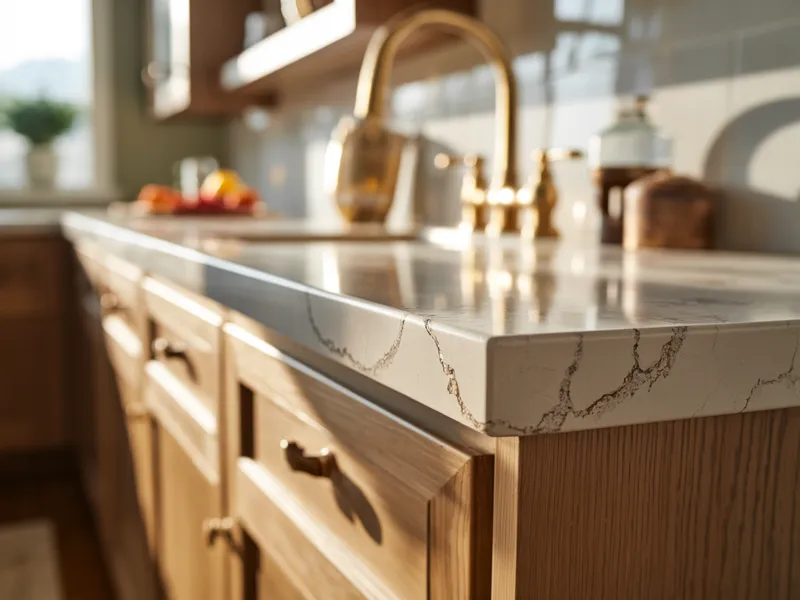
A countertop edge profile is the shape of the countertop's exposed front edge. When a quartz slab is cut to fit your kitchen layout, the raw-cut edge is flat and rough. The fabricator then uses specialized equipment to shape and polish this edge into a specific profile — anything from a simple straight cut to an elaborate decorative curve.
The edge profile is typically applied to all visible edges of the countertop — the front edge facing the room, the edges of peninsula or island overhangs, and sometimes the edges around cutouts. Edges that butt against walls or backsplashes are usually left with a simple flat cut since they won't be visible.
Popular Quartz Countertop Edge Profiles
Straight (Eased) Edge
The straight or eased edge is the simplest and most popular edge profile in modern kitchens. It features a flat, square-cut face with just the sharp corners softened slightly (eased) so they're not knife-sharp to the touch. The result is a clean, minimal look with crisp lines.
Best for: Contemporary, modern, transitional, and minimalist kitchens. The straight edge lets the countertop material speak for itself and pairs beautifully with flat-panel (slab) cabinetry.
Cost: Usually the least expensive edge profile because it requires minimal machining. Many fabricators include the eased edge as the standard (no-upcharge) option.
Considerations: The slightly softened corners are comfortable for everyday use but still relatively angular. Not the best choice for households with small children who are at counter height.
Beveled Edge
A beveled edge features a flat face with a 45-degree angled cut along the top edge. This creates a subtle line of visual interest along the countertop's front — a small geometric detail that catches light differently than the flat surface. Bevels are typically 1/4 to 1/2 inch wide.
Best for: Modern and contemporary kitchens that want a step beyond the basic eased edge without going ornate. The bevel adds a crisp architectural detail that works well with clean-lined cabinetry.
Cost: Slightly more than a standard eased edge, typically a modest upcharge.
Considerations: The bevel can create a thin line where crumbs and debris collect, requiring a quick wipe along the edge during cleaning.
Half Bullnose (Demi Bullnose)
The half bullnose rounds the top edge of the countertop into a smooth curve while leaving the bottom edge flat or slightly eased. This creates a profile that's rounded and comfortable on top with a flat face below — a versatile look that bridges traditional and contemporary design.
Best for: Transitional kitchens, family-friendly homes, and virtually any style. The half bullnose is one of the most universally appealing edge profiles and works with almost every cabinet style.
Cost: Moderate — typically a small upcharge over the standard eased edge.
Considerations: The rounded top edge is comfortable to lean against and safer for households with children. The flat bottom gives a cleaner look than a full bullnose.
Full Bullnose
The full bullnose rounds both the top and bottom edges of the countertop into a completely semicircular profile. When viewed from the front, the edge appears as a smooth, continuous curve from top to bottom.
Best for: Traditional kitchens, bathrooms, and any space where a soft, rounded aesthetic is desired. The full bullnose is a classic choice that's been popular for decades and remains a strong option for traditional and Mediterranean-style South Florida homes.
Cost: Moderate — comparable to the half bullnose.
Considerations: The fully rounded edge can make the countertop appear thinner from certain angles. It's the safest edge profile for homes with small children, as there are no sharp corners or angles.
Ogee Edge
The ogee is a decorative S-shaped curve — an elegant concave-to-convex profile that creates a classic, formal look. It's one of the most ornate standard edge profiles and has been a hallmark of high-end kitchens for generations.
Best for: Traditional, classic, formal, and luxury kitchens. The ogee pairs beautifully with raised-panel cabinetry, ornate hardware, and natural stone looks like Calacatta quartz. It's a popular choice in the upscale homes of Boca Raton, Palm Beach, and Fort Lauderdale.
Cost: Higher than simpler profiles due to the complex machining required. Typically one of the more expensive standard edge options.
Considerations: The curves and grooves in the ogee profile can collect dust and debris, requiring slightly more attention during cleaning. The ornate look can feel out of place in very modern or minimalist kitchens.
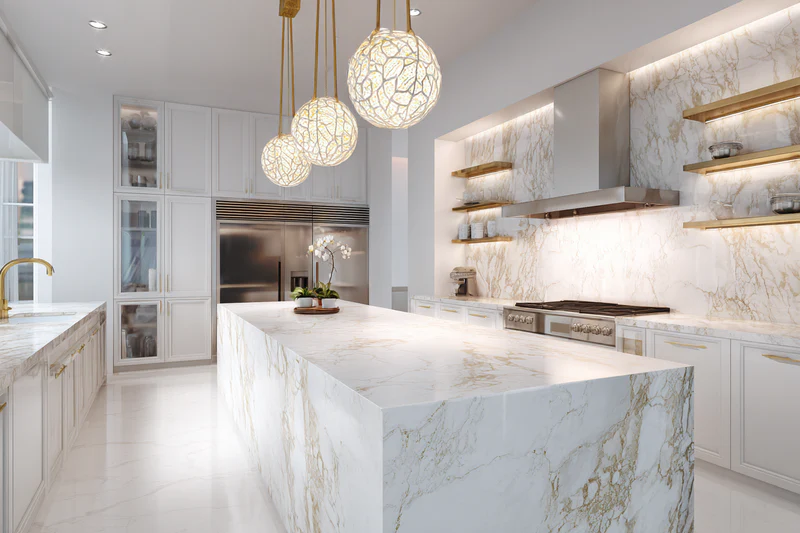
Waterfall Edge
A waterfall edge is a design technique where the countertop material continues vertically down the side of a cabinet or island, creating the appearance that the countertop "falls" over the edge like water. The slab runs horizontally across the top and then turns 90 degrees down to the floor (or to the desired height).
Best for: Modern, contemporary, and high-end kitchens. The waterfall edge is a bold design statement, most commonly used on kitchen islands. It showcases the full thickness and beauty of the quartz slab and creates a dramatic architectural focal point.
Cost: Significantly more than other edge profiles because it requires additional slab material (for the vertical panel), precise mitered cutting at a 45-degree angle, and careful alignment of veining patterns across the seam. This is the most expensive edge option.
Considerations: Veining or pattern matching at the miter joint is critical — this is where fabrication skill really shows. A well-executed waterfall makes the material look like a continuous, seamless flow. A poorly executed one looks disjointed. For more on this design, read our detailed waterfall edge countertop guide.
Mitered Edge
A mitered edge bonds two pieces of quartz at a 45-degree angle to create the appearance of a thicker slab — typically doubling the apparent thickness from 3cm to 6cm (or about 2.5 inches). The result is a substantial, chunky edge that makes a strong visual impact.
Best for: Modern and contemporary kitchens where a bold, substantial countertop is desired. The mitered edge gives the illusion of a solid, heavy slab of stone — creating a luxurious look that's especially dramatic on kitchen islands.
Cost: Higher than standard edges due to the additional material and precision mitering required. Less expensive than a full waterfall but more than most simple edge profiles.
Considerations: The quality of the miter joint is critical. At Griffin Quartz, we use CNC machining to cut perfectly matched 45-degree miters that align seamlessly, creating the illusion of a single thick slab.
Dupont Edge
The Dupont edge features a short, curved concave cut at the top of the edge, transitioning into a straight vertical face. It creates an elegant notch at the top that adds visual dimension without being overly ornate.
Best for: Transitional to traditional kitchens that want subtle elegance without the full formality of an ogee. The Dupont adds enough detail to feel premium while maintaining relatively clean lines.
Cost: Moderate to high — slightly less than an ogee but more than simpler profiles.
Considerations: Similar to the ogee, the concave groove can collect dust and crumbs, requiring a bit more cleaning attention than a flat edge.
Choosing the Right Edge Profile for Your Kitchen Style
| Kitchen Style | Recommended Edge Profiles |
|---|---|
| Modern / Contemporary | Eased, Beveled, Mitered, Waterfall |
| Traditional / Classic | Ogee, Full Bullnose, Dupont |
| Transitional | Half Bullnose, Beveled, Dupont, Eased |
| Minimalist | Eased, Mitered |
| Farmhouse / Cottage | Half Bullnose, Full Bullnose, Eased |
| Mediterranean / Tuscan | Ogee, Full Bullnose, Dupont |
| Coastal / Florida | Half Bullnose, Eased, Waterfall |
Keep in mind that there are no hard rules. The "right" edge profile is the one that looks best in your specific kitchen with your specific cabinets, backsplash, and flooring. That's why we always recommend seeing edge profile samples in person and against your existing finishes.
Cost Differences Between Edge Profiles
Edge profile pricing varies by fabricator, but here's a general hierarchy from least to most expensive:
- Eased / Straight — usually included as the standard edge at no extra charge
- Beveled — minimal upcharge ($5-$10 per linear foot)
- Half Bullnose — moderate upcharge ($8-$15 per linear foot)
- Full Bullnose — moderate upcharge ($8-$15 per linear foot)
- Dupont — moderate to high upcharge ($15-$25 per linear foot)
- Ogee — higher upcharge ($15-$30 per linear foot)
- Mitered — significant upcharge ($30-$60 per linear foot, includes extra material)
- Waterfall — highest cost (priced per project due to additional slab material and fabrication complexity)
For a typical kitchen with 30-40 linear feet of countertop edge, the difference between a standard eased edge and an ogee might be $450-$1,200. A waterfall island adds more significantly to the total project cost because of the additional slab material required.
Use our online quote calculator to see how different edge selections affect the total price for your project.
How CNC Technology Ensures Precision Edge Profiles
The quality of an edge profile depends entirely on the precision of the fabrication equipment and the skill of the fabricator. Modern CNC (computer numerical control) routers are capable of cutting edge profiles with extraordinary accuracy and consistency — far beyond what hand tools can achieve.
At Griffin Quartz, all edge profiling is performed using CNC equipment at our Boca Raton fabrication facility. Here's why that matters:
- Consistency — CNC machines produce the exact same profile across every inch of edge, with no variation. A hand-profiled edge may have subtle inconsistencies; a CNC-cut edge is uniform from start to finish.
- Precision — CNC can execute complex profiles like ogee and Dupont with tight tolerances that would be extremely difficult to achieve by hand.
- Miter accuracy — for mitered and waterfall edges, CNC cuts perfectly matched 45-degree angles that align seamlessly. Even a fraction of a degree off can create a visible gap in the miter joint.
- Polish quality — CNC polishing wheels deliver a consistent, high-quality polish across the entire edge profile, including curved sections.
Because we fabricate in-house rather than outsourcing to a third-party shop, we maintain complete control over quality at every step. Our team inspects every edge before it leaves the facility, and we stand behind the results with a lifetime craftsmanship warranty.
Practical Considerations Beyond Aesthetics
When choosing an edge profile, aesthetics matter most — but a few practical factors are worth considering:
Safety
Sharp-cornered profiles like the eased and beveled edges have more angular contact points than rounded profiles. In homes with young children, a full bullnose or half bullnose is generally the safest choice. Square edges at counter height can cause more painful bumps than rounded ones.
Cleaning
Simpler edge profiles (eased, beveled, half bullnose) are easier to keep clean because they have fewer grooves and curves where crumbs, dust, and grease can accumulate. More ornate profiles (ogee, Dupont) have concave sections that require a bit more attention during cleaning.
Durability
Edges with thin or protruding sections are more susceptible to chipping than solid, rounded profiles. An ogee's delicate curves are slightly more vulnerable to impact than a robust full bullnose. That said, quartz is very chip-resistant overall, and edge damage from normal use is rare with any profile.
Thickness Appearance
Some edge profiles affect how thick the countertop appears. A mitered edge doubles the apparent thickness, making a 3cm slab look like 6cm. A full bullnose can make a 3cm slab appear slightly thinner because the rounded curve doesn't extend the full depth visually. Consider how the perceived thickness works with your overall kitchen proportions.
Frequently Asked Questions
What is the most popular countertop edge profile?
The eased (straight) edge is the most popular countertop edge profile overall, especially in modern and contemporary kitchens. The half bullnose is a close second and is favored in transitional and family-friendly homes. These profiles are popular because they're versatile, affordable, comfortable, and work with virtually any kitchen style.
What countertop edge is best for a modern kitchen?
For modern kitchens, the eased (straight) edge, beveled edge, mitered edge, and waterfall edge are the best choices. These profiles feature clean, geometric lines that complement flat-panel cabinetry and minimalist design. The mitered and waterfall edges create a particularly dramatic, contemporary statement.
How much more does a waterfall edge cost?
A waterfall edge is the most expensive edge option because it requires additional slab material for the vertical panel, precision 45-degree miter cuts, and careful pattern alignment at the seam. The cost varies depending on island size and material, but expect to add $1,500-$5,000+ to your project cost compared to a standard edge. The exact amount depends on the height of the waterfall, the material selected, and the complexity of pattern matching.
Does the edge profile affect the durability of quartz countertops?
The edge profile has a minor effect on durability. Edges with thin or protruding features (like the delicate curves of an ogee) are slightly more susceptible to chipping from heavy impacts than solid, rounded profiles (like a full bullnose). However, quartz is very chip-resistant overall, and edge damage from normal household use is rare regardless of profile. The choice should be driven primarily by aesthetics and comfort.
Can I have different edge profiles on different sections of my countertop?
Yes, absolutely. Many homeowners use a simpler edge (eased or half bullnose) on their perimeter countertops and a more dramatic edge (mitered or waterfall) on their kitchen island. This creates visual hierarchy, draws attention to the island as a focal point, and helps manage costs by reserving the premium edge for the most visible area.
See Edge Profiles in Person
Photos and descriptions can only take you so far. During your free in-home consultation, the Griffin Quartz team will bring edge profile samples so you can hold them against your cabinets, feel the comfort of each shape, and see how they interact with your kitchen lighting. We serve homeowners throughout Palm Beach, Broward, and Miami-Dade counties. Call (720) 324-1436 or request a free estimate online.
Schedule Free Consultation